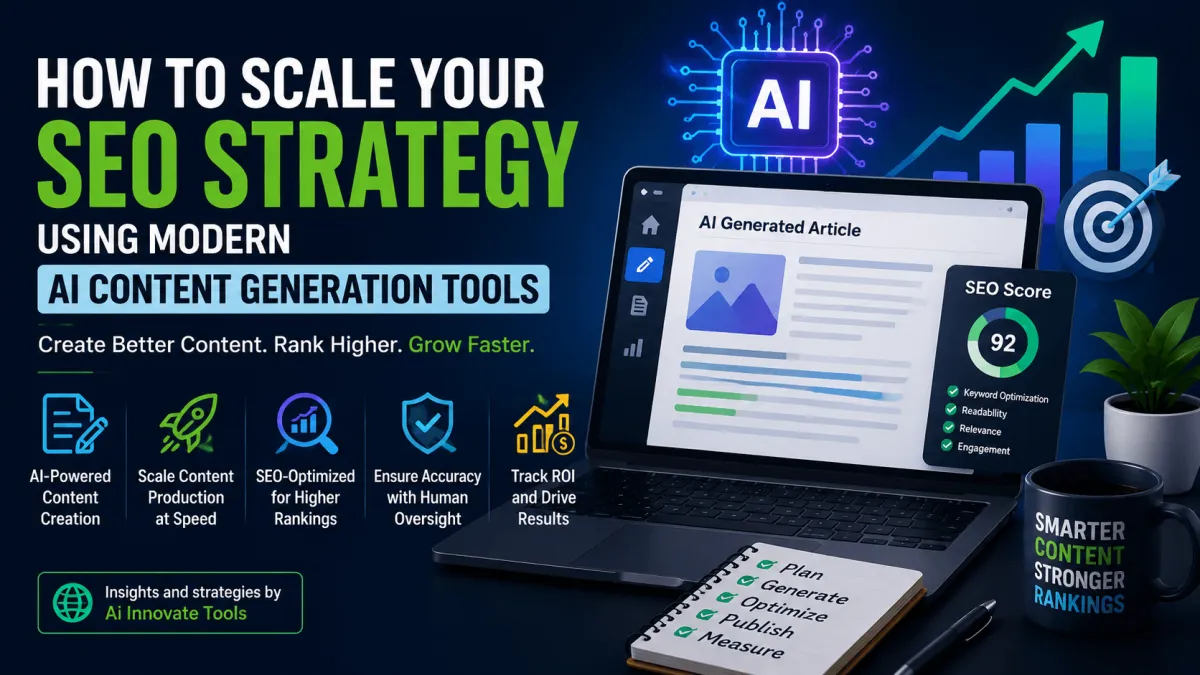
arch engine optimization has become increasingly complex as algorithms evolve and competition intensifies across nearly every industry. Ranking systems are no longer based on simple keyword placement or backlink volume alone, but instead evaluate deeper signals such as user intent satisfaction, content depth, engagement behavior, and topical authority. This shift has forced businesses to rethink how they approach content creation, because success now depends on how well content aligns with both search engine expectations and real user needs. As a result, teams are under constant pressure to produce not just more content, but also more relevant and strategically structured content that can consistently perform across competitive search landscapes.
Businesses are no longer competing only on content quality but also on speed, consistency, and strategic execution. This has created a demand for scalable systems that can maintain output without degrading accuracy or brand voice. AI content generation tools have emerged as a practical response to this challenge, supporting ideation, drafting, and optimization processes at scale. However, their effectiveness is not automatic, since raw output still requires human direction to ensure alignment with SEO goals and editorial standards. The real advantage comes when these tools are integrated into a structured SEO workflow rather than being treated as standalone writing systems. This article, published on Ai Innovate Tools, examines how modern teams can scale SEO effectively using AI while maintaining quality, trust, and measurable performance outcomes.
1. The Evolution of Digital Marketing and Content Creation
Digital marketing has transitioned from slow, manual publishing cycles into fast, data driven ecosystems where content must respond to algorithm updates in near real time. Search engines continuously refine ranking signals, which means static content strategies quickly lose effectiveness. As a result, businesses are under pressure to produce more content while maintaining higher quality standards, which creates a structural imbalance between demand and capacity.
At the same time, marketing budgets are becoming tighter, forcing teams to do more with fewer resources. This has changed content creation from a purely creative task into a hybrid process that combines strategy, automation, and performance tracking. Traditional workflows are no longer sufficient because they cannot match the speed required by modern SEO environments.
AI content generation tools have become a response to this pressure by enabling faster production of structured drafts and topic expansions. However, relying on automation alone can be misleading because speed without direction often produces irrelevant content. The real evolution lies in combining AI efficiency with human strategy, which ensures that output remains aligned with search intent and business goals. Platforms like Ai Innovate Tools reflect this shift by supporting structured workflows rather than replacing human decision making.
Sharing Sensitive Documents Safely Starts With Using the Right PDF Redaction Tool
2. Choosing the Right AI Content Generation Tools for Your Business
The AI tools market has grown rapidly, creating a saturated environment where many platforms appear similar but function very differently under the surface. This makes selection difficult for businesses that lack technical evaluation frameworks. Many teams focus on surface level features such as word generation speed rather than assessing output quality and strategic fit.
A common mistake is subscribing to multiple tools without clearly defining their roles in the content workflow. This leads to duplicated functionality, inconsistent tone, and unnecessary operational costs. Instead of improving efficiency, it often creates fragmentation across content teams and reduces overall control over quality standards.
A more effective approach is to evaluate AI content generation tools based on their ability to integrate into existing SEO systems. This includes compatibility with CMS platforms, keyword planning tools, and editorial workflows. Businesses should also prioritize consistency in output rather than creative variability, because SEO content requires structure and predictability more than randomness. When tools are aligned properly, as seen in ecosystems like Ai Innovate Tools, they become part of a unified content production system rather than isolated utilities.
Cutting Through the Hype to Find the Best AI Tools for Real Work
3. Overcoming the Flaws of Robotic and Repetitive Writing Styles
One of the most noticeable weaknesses of AI generated content is its repetitive structure and mechanical tone. This occurs because language models often rely on statistical patterns rather than contextual understanding. As a result, content can feel uniform, predictable, and lacking in emotional depth, which reduces reader engagement.
This issue becomes more significant in SEO driven environments where user behavior signals such as time on page and bounce rate influence rankings. When content feels artificial, users tend to disengage quickly, which indirectly weakens search performance. Repetition of sentence structures and overused transitions further exposes the automated nature of the text.
The solution is not to avoid AI but to restructure how it is used in the writing process. AI should be responsible for generating drafts, outlines, and variations, while human editors refine tone, structure, and narrative flow. Brand voice guidelines also play a critical role because they ensure consistency across all content pieces. Without editorial refinement, even advanced AI content generation tools produce output that feels generic rather than authoritative.
A Practical Guide to PHP Development Tools Every Developer Should Be Using
4. Integrating Human Editors to Eliminate Inaccuracies and Hallucinations
Despite improvements in AI systems, factual inaccuracies remain a persistent challenge. These errors often appear in the form of hallucinations, where the model generates plausible but incorrect information. In SEO content, this creates a serious risk because credibility is directly linked to ranking performance and user trust.
If inaccurate information is published repeatedly, it can weaken domain authority and reduce long term visibility in search results. This is especially problematic in industries where precision and compliance are important. Search engines increasingly reward trustworthy and well verified content, making accuracy a critical ranking factor.
Human editors play a necessary role in validating AI generated output before publication. Their responsibility extends beyond grammar correction to include fact checking, logical review, and alignment with editorial standards. When combined with AI content generation tools, editorial oversight ensures that speed does not compromise accuracy. Platforms such as Ai Innovate Tools support this hybrid model by allowing teams to generate content efficiently while maintaining structured review processes.
Stop Getting Flagged: Best Online Tools to Humanize AI Text That Actually Work
5. Optimizing Automated Texts to Meet Search Engine Quality Standards
Modern search engines prioritize content quality signals over keyword density, which has changed how optimization strategies must be designed. Content is now evaluated based on usefulness, depth, and how well it satisfies user intent. This means automated content must be carefully structured rather than simply keyword optimized.
A common problem with AI generated content is over optimization, where keywords are repeated excessively in an attempt to improve ranking. This approach often reduces readability and can trigger quality filters in search algorithms. Another issue is generic content that fails to address specific user needs, which limits engagement and reduces ranking potential.
Effective optimization requires guiding AI content generation tools with clear intent based prompts. These prompts should define whether the content is informational, transactional, or comparative in nature. Additionally, readability and semantic structure must be prioritized to ensure content flows naturally. Internal linking strategies also enhance SEO performance by connecting related topics and improving site authority. When used correctly, systems like Ai Innovate Tools help align automated writing with modern SEO standards without compromising user experience.
6. Tracking Return on Investment to Justify Your New Software Stack
Measuring the return on investment of AI content systems is one of the most challenging aspects of adoption. While output volume increases quickly, it is not always clear whether this translates into meaningful business results. Many organizations mistakenly equate higher content production with higher revenue impact.
Attribution becomes complex because multiple marketing channels often contribute to conversions. This makes it difficult to isolate the direct impact of AI generated content. Additionally, increased traffic does not necessarily mean improved performance if users do not engage or convert after landing on the page.
A more reliable approach is to track performance metrics such as engagement rate, dwell time, and conversion behavior. These indicators provide a clearer picture of content effectiveness beyond surface level traffic numbers. Cost analysis should also include editing, tooling, and workflow management expenses to determine true efficiency gains. Businesses using Ai Innovate Tools often implement structured dashboards to monitor these metrics and evaluate whether AI integration is improving overall SEO outcomes or simply increasing production volume.
Conclusion
AI content generation tools have fundamentally changed the way SEO strategies are executed, but their effectiveness depends heavily on implementation quality. They are not standalone solutions but components of a larger content ecosystem that requires strategy, editorial control, and performance tracking. Businesses that treat AI as a replacement for human insight often struggle with quality issues and inconsistent results.
The most successful approach is a hybrid model where AI handles scale and humans ensure accuracy, tone, and strategic alignment. Platforms such as Ai Innovate Tools demonstrate how structured workflows can bridge the gap between automation and editorial intelligence. Ultimately, scaling SEO is not about producing more content, but about producing better aligned content that consistently meets both user intent and search engine expectations.