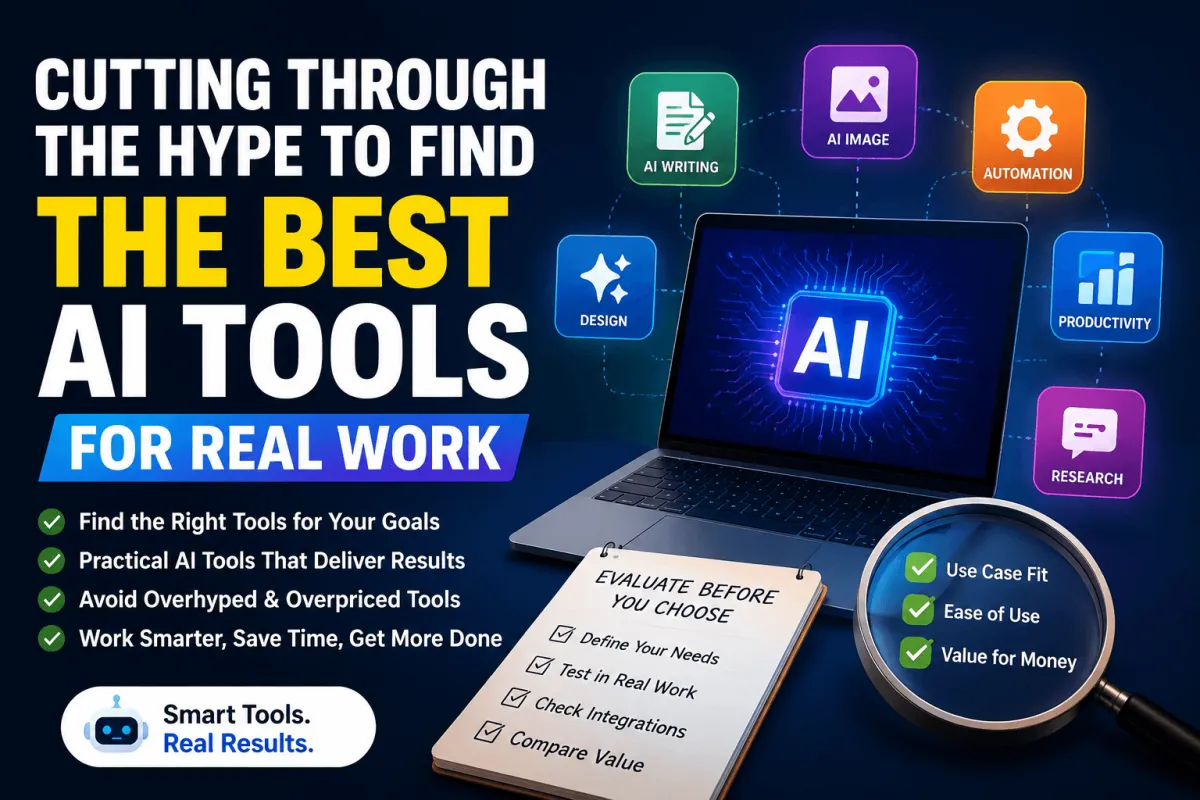
Introduction
The AI landscape is expanding faster than most people can keep up with, and a new tool seems to launch every other day. Each platform claims to be the best AI tool available, promising revolutionary results, but most users either choose tools that are not fit for their workflow or pay for subscriptions they rarely use. The hype around AI can be overwhelming, making it difficult to separate genuinely useful software from those that exist mainly for marketing purposes. Understanding which tools deliver actual value for your work requires evaluating them critically and aligning them with your needs. Ai Innovative Tools provides guidance for finding tools that help professionals, marketers, and developers achieve measurable results instead of chasing flashy features.
Why the Best AI Tool Depends Entirely on What You Do
Finding the best AI tools is rarely about popularity or brand recognition. A tool designed for developers will be nearly useless for marketers, and software built for design workflows often fails for business automation tasks. Most roundup lists focus on what is trending instead of what delivers practical outcomes for specific roles. Experimenting with tools without a defined problem to solve wastes time and money, and it can create unnecessary frustration for teams. The best AI tools are those that align with your daily tasks, solving real problems efficiently rather than promising universal solutions. Knowing your work context, team capabilities, and workflow priorities is the first step in making informed decisions about AI software.
AI Writing Tools: What They Are Good at and Where They Fall Short
AI writing tools are among the most popular categories, and for good reason. They generate text quickly, provide creative prompts, and can assist in drafting articles, emails, or social media posts. However, output quality often declines without proper prompting, and most users lack the expertise to guide AI effectively. Even with high-quality input, generated content still requires careful editing for tone, accuracy, and brand voice. Free tiers are generally restrictive, limiting word counts or features, making them insufficient for professional or high-volume content production. Professionals should approach AI writing tools as assistants rather than replacements, using them to accelerate work while maintaining human oversight.
AI Image and Design Tools: Separating Useful from Overhyped
AI image generators and design software promise visually striking outputs in seconds, but results are inconsistent. Prompt-to-image tools often require multiple iterations to achieve usable results, and users without design experience may struggle to create professional-quality visuals. Licensing and commercial rights remain unclear on many platforms, creating legal risks for businesses. Non-designers frequently spend more time adjusting AI outputs than creating visuals manually, which undermines the value these tools claim to provide. The best AI tools for design integrate user-friendly interfaces, clear usage rights, and customization options that allow non-experts to produce professional results efficiently.
Productivity and Automation AI Tools Businesses Actually Use
AI productivity and automation tools hold significant potential for streamlining workflows, but most require technical knowledge for setup and configuration. Integration failures often occur when connected platforms update their APIs, disrupting automated processes. Measuring the return on investment can be difficult without documenting workflows before automation. Effective AI automation tools are those that simplify repetitive tasks, integrate seamlessly into existing systems, and provide measurable impact on efficiency. Businesses should evaluate automation tools based on how they support daily operations and reduce manual effort rather than on buzzwords or exaggerated marketing claims.
How to Evaluate the Best AI Tools Without Falling for Marketing
Evaluating AI tools critically is essential to avoid being misled by marketing claims. Free trials can be too short to test functionality in real-world scenarios, leaving users with incomplete understanding of a tool’s capabilities. Review platforms often mix paid placements with genuine user feedback, which can distort perception of a product’s effectiveness. Testing AI tools on your own tasks provides more reliable insights than reading comparison articles alone. Professionals should focus on output quality, ease of integration, and whether the tool addresses specific problems effectively. By approaching evaluation with a clear problem to solve, teams can select tools that deliver tangible benefits instead of being swayed by hype.
Paid vs Free AI Tools: When the Upgrade Is Actually Worth It
Free AI tools provide limited access, and the restrictions often only become apparent mid-project. Monthly subscriptions for multiple tools can quickly accumulate, exceeding typical budgets without delivering proportional value. One well-chosen paid tool frequently outperforms several free alternatives used together, providing higher-quality outputs and better support. Deciding whether to invest in a paid AI tool requires understanding the tasks you need to accomplish, evaluating cost against potential productivity gains, and verifying that the tool scales with workflow demands. Paid options are worth the investment when they streamline work, reduce repetitive effort, and maintain quality across projects.
Choosing Tools That Match Your Workflow
The right AI tools fit seamlessly into your existing workflow, helping you solve real problems rather than creating additional complexity. Developers, marketers, designers, and business professionals all require different capabilities, and a single tool cannot satisfy every need. Aligning tool selection with team skill sets and project requirements ensures maximum utility and minimizes wasted time. Focusing on usability, output quality, and integration capabilities is crucial when deciding between multiple options. Tools that enhance workflow efficiency without requiring constant troubleshooting deliver measurable value and justify investment for professional use.
Avoiding the Hype and Measuring True Value
AI tool providers often use buzzwords and exaggerated claims to attract attention. Businesses should be cautious of these marketing tactics and verify performance claims with hands-on testing. Evaluating output accuracy, reliability, and practical applicability provides a more accurate assessment than reviews alone. Tracking time saved, errors reduced, and workflow efficiency improvements helps determine if a tool justifies its cost. By concentrating on tangible results, professionals can cut through the hype and invest in the AI tools that actually make their work easier and more productive.
Realistic Expectations and Human Oversight
No AI tool replaces human judgment entirely, and expecting perfect automation often leads to disappointment. Successful use of AI involves combining machine efficiency with human oversight to ensure outputs meet standards of quality, tone, and accuracy. Professionals must be prepared to edit, validate, and iterate AI-generated content or outputs. Understanding the limitations of each tool helps manage expectations and prevents overreliance on software. The best AI tools complement human skills rather than replace them, allowing teams to scale productivity while maintaining control over outcomes.
Maintaining Cost-Effectiveness While Using AI
Paying for multiple AI tools simultaneously can become a hidden budget drain. Evaluating which tools provide real value and consolidating subscriptions reduces unnecessary expenses. Using free tiers strategically for non-critical tasks can offset costs while still leveraging AI benefits. Regularly reviewing tool usage ensures that only high-impact tools remain in use. One well-integrated paid tool often surpasses the effectiveness of several fragmented free tools, delivering more consistent results and predictable ROI. This approach ensures teams achieve productivity gains without overspending on software that provides minimal benefit.
Conclusion
The best AI tools are those that align directly with the tasks you perform, complement human skills, and deliver measurable results. Popularity alone does not determine usefulness, and careful evaluation is essential to avoid wasting time and resources. Testing tools on real tasks, understanding licensing restrictions, and integrating software into existing workflows produces meaningful improvements in efficiency. Paid tools are often justified when they save time, enhance quality, and scale with project needs. Following these guidelines helps professionals navigate the AI landscape intelligently and invest in the tools that actually support real work. For additional insights and curated lists of tools that truly deliver value, visit Ai Innovative Tools, where practical advice guides you through selecting software that improves efficiency and productivity.