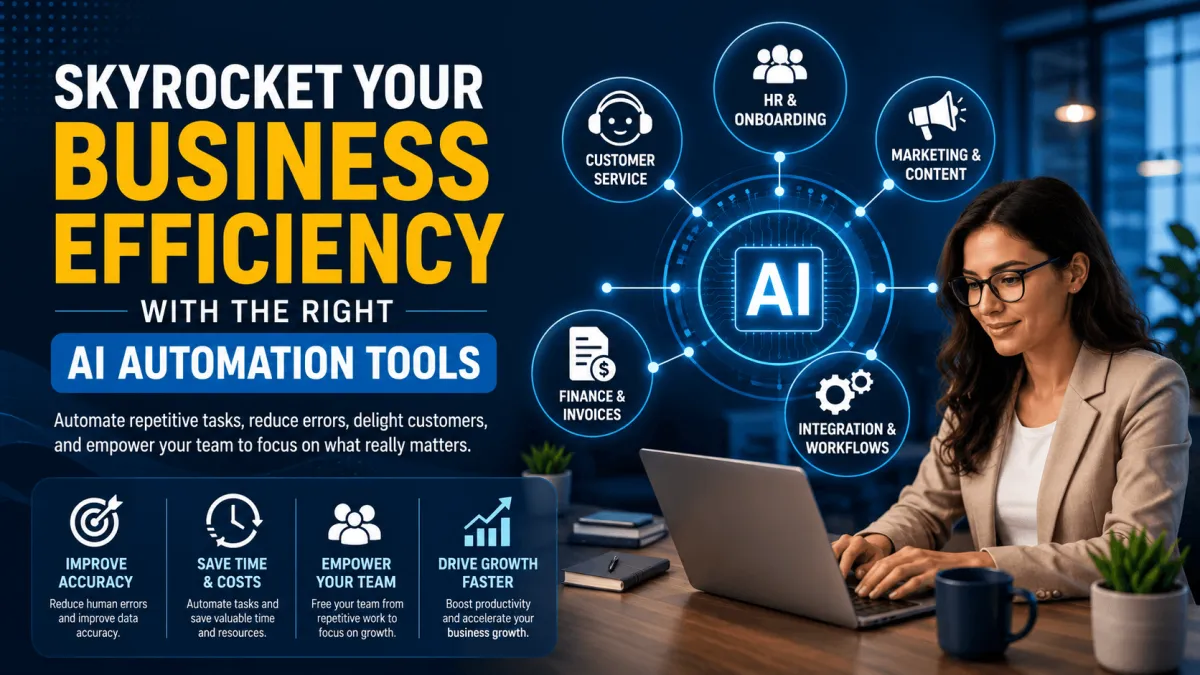
Businesses today operate in an increasingly competitive environment where speed, accuracy, and productivity directly influence success. Yet many organizations still depend on manual processes that consume valuable working hours every single day. Employees often spend more time updating spreadsheets, organizing documents, and entering data than solving problems or creating meaningful business strategies. Adopting AI automation tools allows companies to reduce repetitive workloads while helping teams focus on higher value responsibilities that drive measurable growth.
Manual processes also increase the likelihood of costly mistakes that affect customer satisfaction and business performance. A single data entry error can lead to incorrect invoices, inaccurate reports, or delayed project decisions. These issues create unnecessary stress for employees while reducing operational efficiency. Modern AI powered solutions minimize repetitive tasks through intelligent workflows, allowing businesses to improve consistency without sacrificing quality or control.
The shift toward intelligent automation is no longer limited to large enterprises with significant technology budgets. Small and medium sized businesses now have access to affordable platforms that automate routine operations across multiple departments. At AI Innovate Tools, we believe organizations achieve the greatest results when technology supports employees rather than replacing them. Businesses that embrace automation today position themselves for greater productivity and long term competitiveness tomorrow.
Eliminating Customer Service Bottlenecks
Customer expectations continue to rise as people expect quick, accurate, and personalized responses at any time of day. Unfortunately, support teams often struggle during busy periods because they must answer hundreds of similar questions repeatedly. Delayed responses can frustrate customers, reduce trust, and increase the risk of losing valuable business opportunities. Implementing AI automation tools helps organizations provide faster assistance without placing additional pressure on customer support representatives.
AI powered chatbots and virtual assistants can instantly respond to common inquiries, including order tracking, appointment scheduling, password resets, and product information. These systems operate around the clock, ensuring customers receive immediate assistance even outside regular business hours. Human agents can then dedicate their attention to more complex situations that require empathy, critical thinking, and personalized decision making.
Automation also improves customer experiences by organizing conversations, collecting relevant information, and routing requests to the appropriate departments automatically. Instead of repeating their concerns multiple times, customers receive smoother interactions with shorter resolution times. Businesses benefit from improved efficiency, while support teams experience reduced workloads and greater job satisfaction because they spend more time solving meaningful problems instead of repeating routine answers.
Sharing Sensitive Documents Safely Starts With Using the Right PDF Redaction Tool
Simplifying HR and Onboarding Processes
Human resources teams manage many essential responsibilities, yet repetitive administrative work often limits the time available for employee engagement. Processing paperwork, collecting documents, scheduling interviews, and tracking compliance can quickly become overwhelming as organizations grow. AI automation tools simplify these routine activities by handling repetitive workflows while allowing HR professionals to focus on building stronger workplace relationships.
New employees also benefit from a more organized onboarding experience. Instead of waiting for emails or manually completed forms, automated systems can provide welcome materials, training schedules, policy documents, and task reminders from the first day. This structured approach helps new hires understand expectations more quickly while reducing confusion during their transition into the company.
Automation also improves accuracy by securely storing employee information and reducing manual data entry across different HR systems. Managers gain better visibility into onboarding progress, while employees receive consistent support throughout the process. As a result, organizations create a more positive first impression and improve long term employee satisfaction.
Cutting Through the Hype to Find the Best AI Tools for Real Work
Upgrading Marketing Campaigns and Content Creation
Marketing teams often face increasing pressure to produce fresh content across multiple channels while maintaining quality and consistency. Creating blog posts, email campaigns, social media updates, and promotional materials manually requires significant time and creative effort. AI automation tools help marketers streamline repetitive tasks, allowing them to focus more on strategy, creativity, and campaign performance.
Artificial intelligence can assist with generating content ideas, drafting outlines, scheduling posts, and analyzing campaign results. While human creativity remains essential, automation reduces the workload involved in repetitive production tasks. This balance enables marketing teams to publish high quality content more consistently without sacrificing originality or brand identity.
Personalized communication also becomes more effective through automation. AI powered systems can segment audiences based on customer behavior, interests, or purchase history before delivering targeted email campaigns. Instead of sending identical messages to everyone, businesses create more relevant experiences that improve engagement, strengthen customer relationships, and increase conversion opportunities.
A Practical Guide to PHP Development Tools Every Developer Should Be Using
Improving Financial Operations and Invoice Processing
Financial departments depend on accuracy, yet manual approval processes often create unnecessary delays and operational challenges. Invoices can remain trapped in long email chains, causing missed payment deadlines and disrupting healthy cash flow. AI automation tools accelerate these workflows by automatically routing invoices, sending approval reminders, and tracking payment status in real time.
Automation also reduces the burden of reviewing financial records manually. Intelligent systems can identify duplicate invoices, unusual transactions, missing information, or potential discrepancies before they become larger issues. This additional layer of verification helps finance teams improve accuracy while reducing the time required for routine audits and reconciliation tasks.
By automating repetitive financial processes, organizations gain faster reporting, improved visibility, and stronger control over business expenses. Finance professionals can spend less time processing paperwork and more time supporting strategic financial planning. This shift enables businesses to make informed decisions with greater confidence while maintaining efficient day to day operations.
Stop Getting Flagged: Best Online Tools to Humanize AI Text That Actually Work
Integrating AI Automation Tools into Your Current Systems
Introducing new technology often raises concerns about disrupting established workflows and daily business operations. Many organizations hesitate because they worry employees will struggle to adapt or existing software will become incompatible. The most successful approach is to implement AI automation tools gradually, beginning with repetitive processes that deliver immediate improvements without interrupting essential business functions.
Integration becomes much easier when automation platforms connect smoothly with existing customer relationship management systems, accounting software, communication platforms, and project management tools. This connectivity reduces data silos by allowing departments to share accurate information automatically. Instead of switching between multiple applications or manually transferring records, employees can access consistent data from a unified workflow.
Employee involvement also plays a critical role in successful implementation. Teams should receive clear communication, practical training, and ongoing support throughout the transition process. When employees understand how automation improves their daily responsibilities instead of complicating them, adoption becomes faster and resistance naturally decreases. Businesses that combine technology with effective change management achieve stronger long term results.
Conclusion
The future of business is not about replacing people with technology but empowering employees with smarter tools. AI automation tools remove repetitive administrative work, improve operational accuracy, and allow teams to dedicate more time to creative thinking, customer relationships, and strategic decision making. Organizations that embrace intelligent automation today build stronger foundations for sustainable growth tomorrow.
Successful adoption depends on preparing employees alongside implementing new technology. Providing practical training, encouraging continuous learning, and involving staff throughout the transition builds confidence while reducing uncertainty. When employees understand how automation supports their roles, they become active participants in driving innovation across the business.
Businesses that invest in intelligent automation position themselves to respond more effectively to changing customer expectations and evolving market demands. Whether improving customer support, marketing, human resources, or financial operations, the right automation strategy delivers measurable value across every department. At AI Innovate Tools, we believe organizations achieve the greatest success by combining human expertise with intelligent technology to create faster, smarter, and more efficient ways of working.