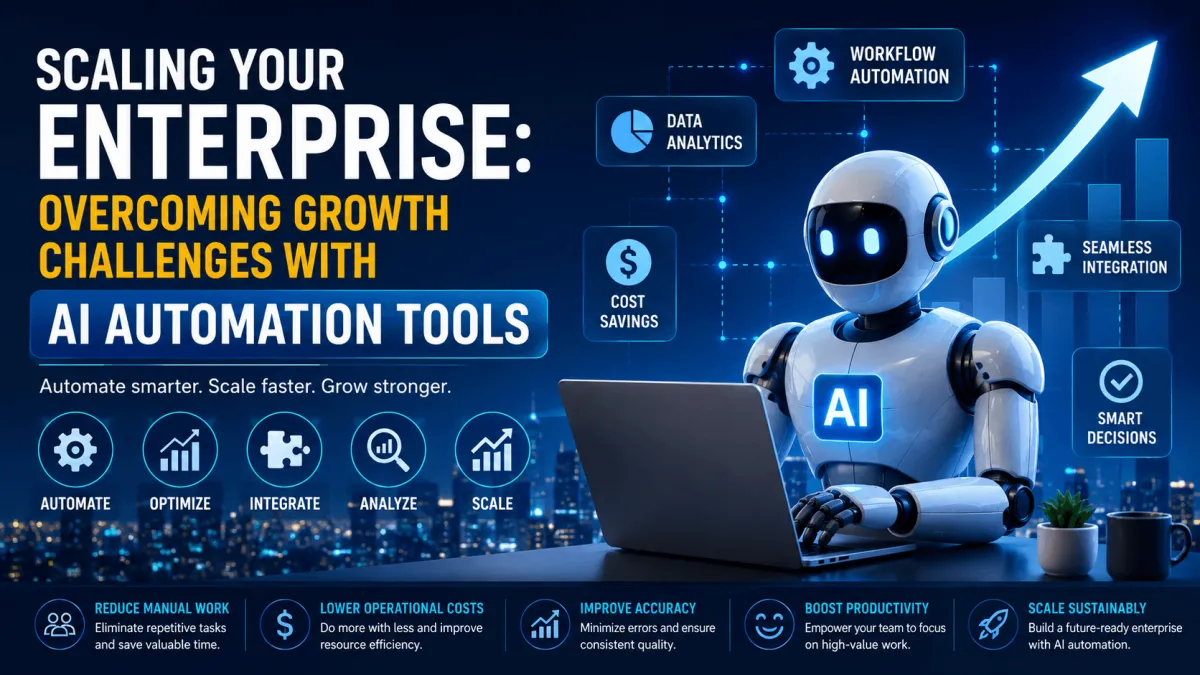
Growing a business is exciting, but rapid expansion often creates unexpected operational challenges. Many companies discover that processes which worked perfectly for a small team become ineffective as workloads increase. Employees begin spending more time on repetitive tasks, causing delays across multiple departments.
As we often discuss at AI Innovate Tools, relying on manual processes becomes unsustainable as organizations scale. Hiring more employees to manage increasing workloads is expensive and does not always improve efficiency.
This is where AI automation tools become essential for modern enterprises. These technologies automate repetitive tasks, improve productivity, and help businesses grow sustainably while maintaining operational efficiency and customer satisfaction.
Identifying the Best Processes to Automate First
Many business leaders feel overwhelmed when beginning their digital transformation journey. Every department appears to have inefficiencies, making it difficult to decide where automation should start. Attempting to automate everything simultaneously often creates confusion and wastes valuable resources.
Organizations should begin by identifying repetitive, time consuming, and rule based tasks. Activities such as data entry, invoice processing, appointment scheduling, and customer support are excellent starting points. These processes typically deliver immediate improvements once automated.
Companies should avoid automating inefficient systems without reviewing them first. A broken process will remain broken even after automation. Businesses must simplify workflows, remove unnecessary steps, and then introduce intelligent solutions to maximize long term benefits.
You may also like:
Evaluating the Best AI Automation Tools on the Market
Today's market offers thousands of solutions, making software selection extremely difficult. Buyers are often overwhelmed by technical terminology and marketing promises. Many organizations struggle to distinguish between simple workflow automation and true artificial intelligence capabilities.
Traditional workflow platforms execute tasks according to predefined rules. In contrast, advanced AI automation tools can analyze information, identify patterns, and support decision making. Understanding this difference helps businesses choose solutions that align with their objectives.
Before purchasing any platform, organizations should evaluate scalability, security, integrations, ease of use, and customer support. Businesses should never choose software simply because competitors are using it. The ideal solution is one that directly addresses specific operational challenges.
Some tools are given here:
You may also like:
Securing Company Data While Using Smart Systems
Data privacy is one of the biggest concerns surrounding artificial intelligence adoption. Intelligent systems often connect multiple applications and databases together. Without proper management, these connections can expose sensitive customer and company information.
Organizations should implement strict access controls so employees only view information relevant to their responsibilities. This approach minimizes accidental data exposure and reduces overall cybersecurity risks. Proper permission management is essential for every enterprise.
Companies should also prioritize vendors that comply with recognized security standards. Certifications such as ISO 27001, SOC 2, and GDPR compliance demonstrate a strong commitment to data protection. Regular security audits further strengthen the organization's defenses against potential threats.
You may also like:
Measuring the Real ROI of Your Automation Investment
Many executives struggle to prove whether automation investments are truly beneficial. Without clear metrics, it becomes difficult to justify software renewals or future technology budgets. Establishing measurable goals before implementation is extremely important.
Businesses should track indicators such as time savings, cost reductions, error rates, customer satisfaction, and employee productivity. These measurements provide tangible evidence of success and help leadership teams make informed decisions.
Organizations should avoid evaluating results too quickly. Some automation benefits require several months before becoming noticeable. Long term analysis provides a more accurate understanding of how technology contributes to sustainable growth and operational efficiency.
You may also like:
Training Your Workforce to Collaborate with Smart Systems
Technology alone cannot transform a company without employee participation. Staff members must understand how to effectively use intelligent systems within their daily responsibilities. Otherwise, expensive software may remain underutilized across the organization.
Many employees fear that artificial intelligence will eventually replace their jobs. Leaders should communicate that automation is designed to support employees rather than eliminate them. The objective is to remove repetitive work and allow teams to focus on higher value tasks.
Training programs should emphasize practical applications instead of technical complexity. Employees should learn platform navigation, data interpretation, and workflow management skills. Companies that invest in continuous learning create a workforce that adapts more easily to future technological changes.
You may also like:
Conclusion
Enterprise growth inevitably creates operational challenges that cannot be solved through manual work alone. As workloads increase, traditional processes become inefficient and expensive to maintain. Businesses need smarter solutions that support long term expansion.
AI automation tools help organizations improve productivity, reduce costs, and strengthen overall performance. Success depends on choosing the right processes to automate, securing company data, and measuring outcomes effectively.
Companies that embrace intelligent automation today will be better prepared for tomorrow's challenges. Businesses can also stay updated through platforms like AI Innovate Tools, where emerging technologies and practical automation strategies help organizations scale sustainably.