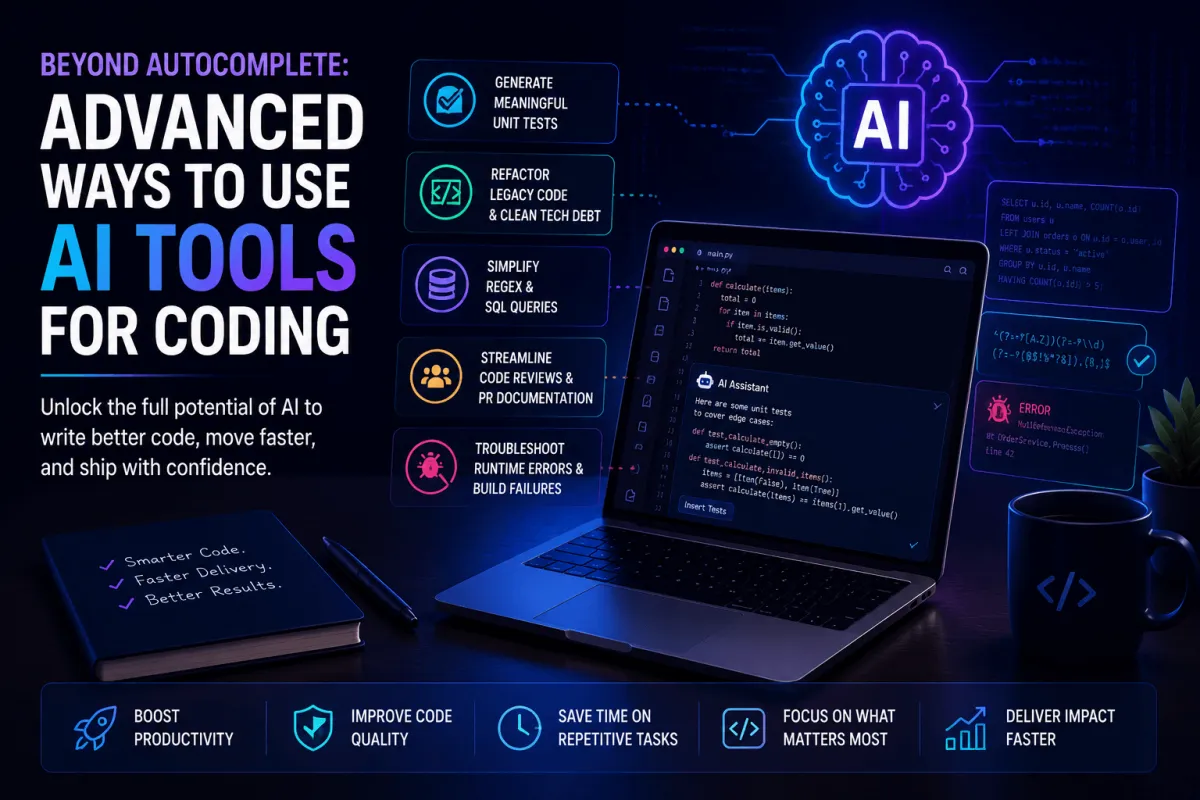
Moving past basic suggestions requires a deeper understanding of how to fully utilize ai tools for coding in real development environments. Most developers initially use AI for autocomplete, simple function generation, or quick debugging hints. However, modern systems are capable of far more advanced workflow automation and architectural support.
The real value of AI emerges when it becomes integrated into testing, refactoring, review processes, and system level debugging. These advanced use cases can significantly reduce engineering effort while improving code quality across large projects.
At Ai Innovate Tools, we focus on practical applications that go beyond surface level usage. Understanding these deeper capabilities allows developers to unlock higher productivity and reduce repetitive engineering work.
Automating the Generation of Meaningful Unit Tests
One of the most powerful applications of ai tools for coding is automated unit test generation. These tools can generate structured test cases that cover multiple edge conditions and functional flows. This reduces the manual effort required to build baseline test coverage for new features.
However, a common issue arises when AI generates hallucinated assumptions that pass locally but fail in real environments. These tests may not correctly reflect external dependencies or real system behavior. This creates a false sense of confidence in code stability.
Another challenge is repetitive boilerplate creation for edge cases. Developers often spend significant time writing similar validation logic across multiple modules. AI can assist in generating structured test templates, but human review is still required to ensure real world accuracy.
When properly guided, AI tools can significantly improve test coverage and reduce regression risk in production systems.
You may also like:
Accelerating Legacy Code Refactoring and Tech Debt Cleanup
Legacy systems are often difficult to maintain due to missing documentation and outdated architecture patterns. This is where ai tools for coding can provide meaningful value by analyzing older codebases and suggesting safer refactoring paths.
A major pain point is incorrect context interpretation, where AI modifies code logic without fully understanding system dependencies. This can unintentionally break production workflows if not carefully validated. Developers must always review structural changes before applying them.
Another issue is the lack of documentation in older systems. Many enterprise applications have evolved over decades, leaving behind unclear logic and inconsistent design patterns. AI can help reconstruct partial documentation by analyzing code structure and usage patterns.
At Ai Innovate Tools, we recommend using AI as a supporting assistant rather than a full automation engine when working with legacy systems. Controlled refactoring ensures stability while still improving code maintainability.
You may also like:
Simplifying Complex Regular Expressions and SQL Queries
Complex regular expressions and SQL queries are often difficult to read and maintain, even for experienced developers. Modern ai tools for coding can simplify these patterns by generating optimized and human readable versions.
A key concern in SQL optimization is hidden performance degradation caused by inefficient joins or poorly structured queries. AI generated suggestions may sometimes overlook indexing strategies or database specific constraints. This requires careful validation before deployment.
Regular expressions also present readability challenges due to deeply nested patterns and multiple conditional groups. AI tools can translate these into simplified logic or step by step breakdowns that are easier to understand.
While these tools improve clarity, developers must still validate performance implications in real environments. This ensures that simplification does not introduce new inefficiencies in production systems.
You may also like:
Streamlining Code Reviews and Pull Request Documentation
Code review processes can be significantly enhanced using ai tools for coding, especially when handling large development teams. AI can automatically generate pull request summaries that describe functional changes and affected modules.
However, a common limitation is that these summaries often lack business context. They may describe what changed in the code but fail to explain why the change was necessary. This reduces their value during stakeholder review discussions.
Another challenge is missing subtle architectural issues. AI may overlook violations of internal design patterns or team specific conventions. This is why human reviewers are still essential in maintaining system consistency.
When used correctly, AI can reduce review time by highlighting structural changes, dependencies, and potential risk areas. This allows engineers to focus more on logic validation rather than documentation tasks.
You may also like:
Troubleshooting Cryptic Runtime Exceptions and Build Failures
Debugging runtime exceptions is one of the most time consuming tasks in software engineering. Advanced ai tools for coding can assist by analyzing stack traces and suggesting potential root causes based on historical patterns.
A major issue in debugging is the presence of generic stack traces that do not clearly identify the underlying problem. Developers often spend hours searching through logs or external forums without finding relevant solutions. AI can help narrow down potential causes more efficiently.
However, AI generated debugging suggestions may sometimes lack precision when dealing with complex distributed systems. It might suggest common fixes that do not apply to the specific architecture being used. This requires careful filtering by experienced developers.
Despite these limitations, AI significantly reduces time spent on initial diagnosis. It helps engineers focus on targeted investigation instead of broad unrelated searches, improving overall sprint efficiency.
You may also like:
Conclusion
The future of software engineering lies in moving beyond basic usage and fully integrating ai tools for coding into advanced development workflows. These tools are no longer limited to autocomplete features but are becoming essential assistants in testing, refactoring, review, and debugging processes.
As demonstrated in this guide, AI can generate unit tests, assist with legacy code cleanup, simplify complex queries, enhance code reviews, and accelerate troubleshooting. However, each use case requires careful validation to avoid incorrect assumptions or incomplete analysis.
At Ai Innovate Tools, we believe the next evolution of development workflows will be defined by how effectively engineers combine AI assistance with human judgment. Developers who master this balance will achieve significantly higher productivity and code quality in modern software systems.