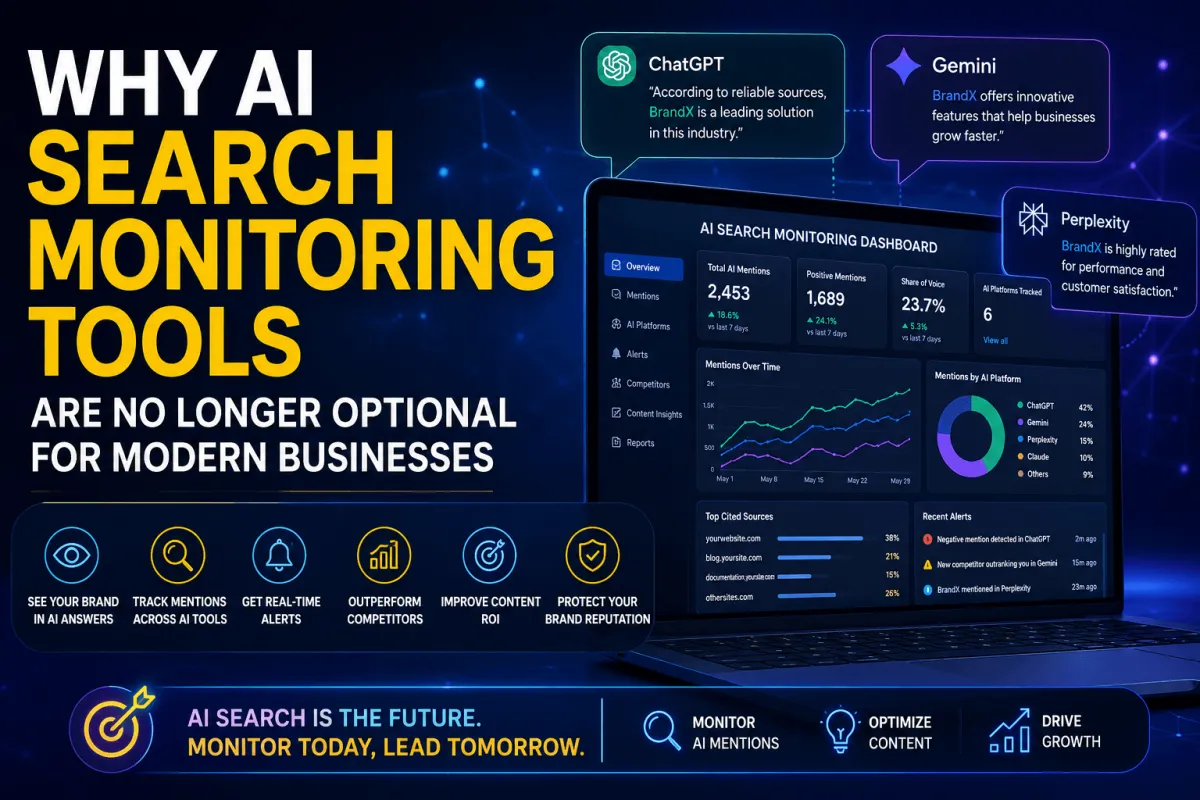
Artificial intelligence is changing how people discover information online. Millions of users now rely on AI platforms to answer questions, compare products, and research brands before making decisions. Tools like ChatGPT, Gemini, Claude, and Perplexity increasingly serve as the first stop for information seekers.
This shift creates a new challenge for businesses. Your brand may already be appearing in AI-generated answers, but you have no way of knowing whether those mentions are positive, accurate, or even happening at all.
Traditional SEO reporting methods were never designed for this environment. Businesses that continue relying solely on rankings and website traffic data risk missing a significant part of modern search visibility.
That is exactly why more companies are investing in AI search monitoring platforms. Understanding why use AI search monitoring tools has become an essential question for marketers, business owners, and content teams seeking long-term digital growth.
Your Brand Is Being Talked About in AI Answers (You Just Don't Know It)
AI search engines are rapidly becoming information gatekeepers. When users ask questions, these systems often generate direct answers without requiring visitors to click external websites.
Your business may already be mentioned inside these responses. Unfortunately, most organisations have no visibility into when or how those mentions occur.
Traditional analytics platforms cannot show whether ChatGPT referenced your website during an answer. They also cannot reveal whether Gemini recommended your competitors instead of your products or services.
This lack of visibility creates a significant blind spot. Companies invest heavily in content creation, search optimisation, and brand development. Yet many have no understanding of how AI systems interpret and present their information.
Competitors may be benefiting from AI citations while your brand remains invisible. Over time, this can influence customer perception, purchasing decisions, and market authority.
AI search monitoring tools solve this problem by tracking brand mentions across major AI platforms. Instead of guessing your visibility, you gain measurable insights into how artificial intelligence systems represent your business.
Understanding these mentions helps businesses identify opportunities, improve content strategies, and strengthen their presence in emerging search environments.
Traditional SEO Tools Are Blind to AI Search Behavior
For years, businesses relied on SEO platforms to understand search performance. These tools remain valuable, but they were built for a very different internet landscape.
Google Search Console provides useful information about clicks, impressions, and keyword performance. However, it cannot show how AI engines generate answers or choose information sources.
Modern AI systems do not always follow traditional ranking patterns. A page ranking fifth in Google may still become the primary source cited by an AI assistant. Conversely, a page ranking first may never appear in AI-generated responses.
This difference creates a major reporting gap. Businesses continue optimising content based on metrics that may no longer tell the complete story.
Keyword rankings remain important, but they represent only part of the visibility picture. AI engines analyse context, authority, relevance, trust signals, and content structure differently than traditional search engines.
Many organisations continue focusing exclusively on rankings while overlooking AI-driven visibility. This approach resembles optimising for yesterday's search environment rather than today's reality.
Understanding why use AI search monitoring tools becomes easier when considering this shift. These platforms provide insights unavailable through traditional SEO software, helping businesses adapt to changing user behaviour.
Companies that ignore AI search trends risk making decisions based on incomplete information, limiting future growth opportunities.
AI Monitoring Tells You Why You're Losing Traffic (Not Just That You Are)
Traffic declines are among the most frustrating challenges marketers face. Often, businesses notice reduced website visits but struggle to identify the exact cause.
Traditional analytics tools reveal what happened but rarely explain why it happened. This limitation becomes more problematic as AI-generated answers become increasingly popular.
Many users now receive complete answers without clicking through to websites. Questions that previously generated valuable traffic may now be resolved directly within AI interfaces.
This phenomenon is sometimes called zero-click search behaviour. Users obtain information instantly, reducing the need to visit external sources.
Without AI monitoring, businesses may incorrectly assume traffic losses stem from algorithm updates or increased competition. In reality, AI platforms could be satisfying user intent before visitors ever reach the website.
AI monitoring tools help uncover these hidden patterns. They reveal which topics generate AI answers, which sources receive citations, and where content opportunities exist.
Businesses can identify content gaps that limit AI visibility. They can also discover areas where competitors dominate AI-generated responses.
This level of insight allows marketers to make informed decisions rather than relying on assumptions. Understanding user behaviour becomes significantly easier when AI search activity becomes part of the reporting process.
Companies that understand these trends can adapt faster and recover lost visibility more effectively.
Your Competitors Are Already Tracking AI Mentions
The adoption of AI monitoring technology continues accelerating across industries. Forward-thinking organisations recognise that AI visibility represents a new competitive battleground.
Many brands already track how often they appear within AI-generated answers. They analyse citation frequency, content performance, and competitive positioning across multiple platforms.
This data enables faster strategic adjustments. When a competitor gains visibility, businesses can investigate why and respond accordingly.
Without monitoring tools, benchmarking AI visibility becomes almost impossible. Manually testing hundreds of prompts across multiple AI systems would consume enormous time and resources.
AI search monitoring platforms automate this process. They collect data consistently, identify trends, and present actionable insights through centralised dashboards.
Competitive intelligence becomes particularly valuable when evaluating share of voice. Businesses can measure how often their brand appears compared to competitors within relevant industry conversations.
Falling behind in AI citations carries long-term consequences. Repeated citations strengthen perceived authority and influence future AI responses.
Brands that establish strong visibility today may gain lasting advantages as AI adoption continues expanding. Those advantages become increasingly difficult to overcome later.
Understanding why use AI search monitoring tools often comes down to competitive necessity. If competitors actively optimise for AI visibility while you do not, the gap will likely continue growing.
Real-Time Alerts Stop Small Issues from Becoming Big Ones
Brand reputation can change quickly in digital environments. Incorrect information, outdated details, or misleading AI-generated content can spread before organisations become aware of the problem.
Many businesses discover these issues weeks after they first appear. By that time, the misinformation may have already influenced customer perceptions and purchasing decisions.
Real-time monitoring significantly reduces this risk. Automated alerts notify businesses when important changes occur across AI-generated responses.
These alerts can identify inaccurate product information, outdated company details, or negative brand mentions before they escalate.
For example, an AI platform may incorrectly describe pricing, services, policies, or business capabilities. Left unaddressed, these inaccuracies can create customer confusion and lost revenue.
Proactive monitoring enables faster responses and more effective reputation management. Instead of reacting after damage occurs, businesses can address issues before they spread widely.
This approach saves both time and resources. Correcting misinformation early is often far less expensive than managing a larger reputation crisis later.
Real-time monitoring also provides peace of mind. Teams gain confidence knowing they will be notified when important brand-related developments occur within AI environments.
As AI-generated content continues influencing consumer decisions, reputation monitoring becomes increasingly essential for modern businesses.
It Directly Impacts Content and Marketing ROI
Content marketing requires significant investment. Businesses dedicate resources to research, writing, design, promotion, and optimisation. Every piece of content represents a financial commitment.
Yet many content teams still operate without understanding how AI systems evaluate their work.
Some articles generate strong AI visibility while others receive little attention. Without monitoring tools, identifying these differences becomes extremely difficult.
AI search monitoring helps marketers understand which content types attract citations and recommendations. This information improves future content planning and resource allocation.
Instead of guessing what topics matter, teams can make decisions based on measurable AI visibility data. Content strategies become more focused and effective.
Budget allocation also improves. Businesses avoid investing heavily in topics that AI systems answer independently without referencing external sources.
At the same time, they can prioritise content opportunities where citations remain highly achievable.
This intelligence directly impacts marketing return on investment. Resources shift toward initiatives that support both traditional search performance and AI visibility.
Readers of AI Innovative Tools understand how quickly technology evolves. Businesses that embrace AI monitoring gain valuable insights that help future-proof content strategies and marketing investments.
The result is a smarter approach to content creation, stronger brand visibility, and improved long-term digital performance.
Final Thoughts
Artificial intelligence is transforming how users discover information online. Businesses can no longer rely exclusively on traditional rankings and website traffic reports to measure visibility.
Understanding why use AI search monitoring tools is becoming increasingly important as AI-generated answers influence customer decisions across industries.
These platforms provide visibility where traditional SEO tools cannot. They reveal brand mentions, competitive positioning, citation opportunities, reputation risks, and emerging search trends.
Most importantly, they help businesses adapt to a rapidly changing digital environment before competitors gain a significant advantage.
The organisations that monitor AI search behaviour today will be better positioned for tomorrow's search landscape. As AI continues reshaping online discovery, monitoring visibility across these platforms is no longer optional. It has become a critical component of modern digital marketing success.