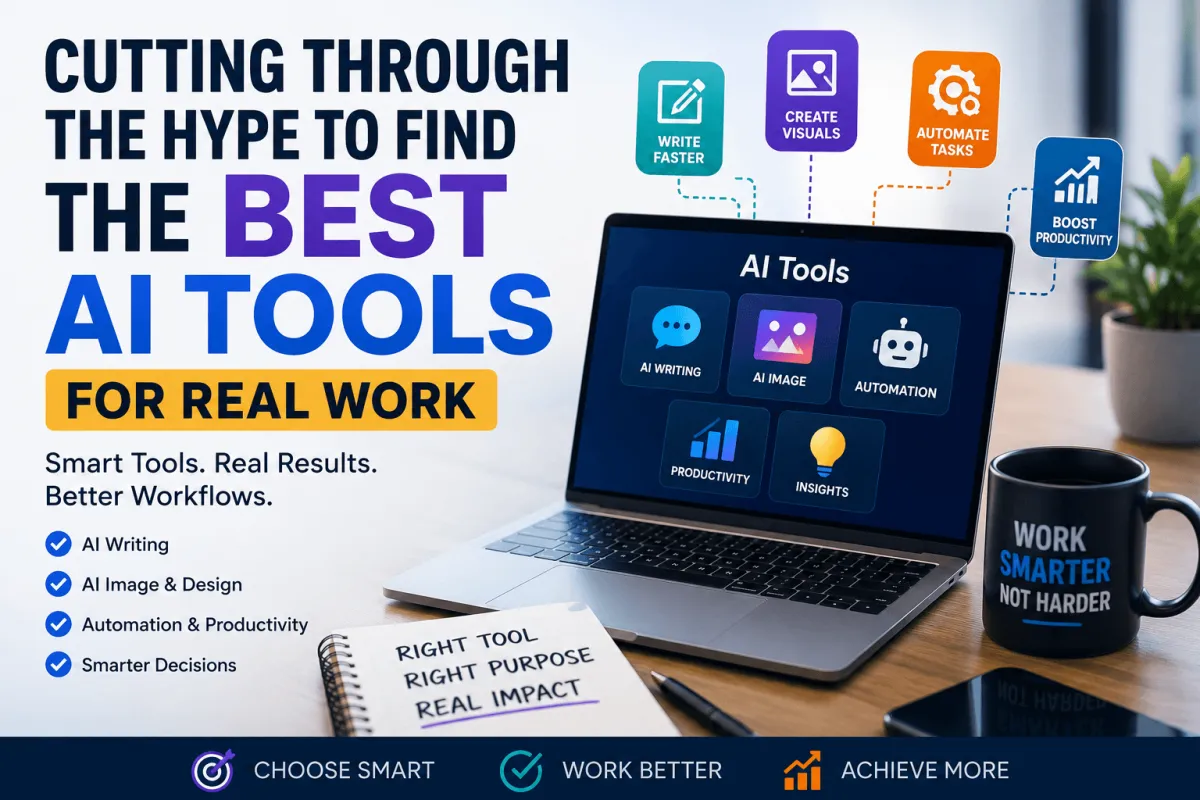
It feels like a new AI platform launches every other day. Social media feeds are packed with influencers claiming they have discovered the next revolutionary tool that will change the way people work forever. At the same time, businesses and professionals are rushing to subscribe before they get left behind. The result is a crowded marketplace where it becomes difficult to separate useful technology from clever marketing campaigns.
Many people end up paying for subscriptions they barely use because they choose tools based on popularity instead of actual needs. Others jump from one platform to another without understanding what problem they are trying to solve. Finding the best AI tools is not about following trends. It is about identifying practical solutions that fit your workflow and improve productivity in measurable ways.
Why the "Best AI Tool" Depends Entirely on What You Do
The biggest mistake people make is assuming there is one AI tool that works for everyone. In reality, the right solution depends entirely on your role, goals, and daily responsibilities. A developer building software has completely different requirements than a content marketer managing multiple campaigns. A designer will also prioritize different features than a business owner handling operations.
Many articles ranking the best AI tools simply list the most popular platforms available today. Popularity does not automatically mean usefulness for every individual. Trying random tools without a specific objective often leads to wasted time and unnecessary expenses. Before choosing any AI platform, define the exact problem you need to solve. This approach immediately narrows your options and improves decision making.
AI Writing Tools: What They Are Good at and Where They Fall Short
AI writing tools have become some of the most widely used applications in recent years. They help users generate blog posts, emails, product descriptions, social media captions, and business documents within minutes. These tools are excellent for brainstorming ideas, creating first drafts, and speeding up repetitive writing tasks.
However, many users expect perfect results without providing proper instructions. Output quality drops significantly when prompts are vague or incomplete. Even high quality generated content requires editing for accuracy, tone, and brand consistency. Free plans are also heavily restricted, making them difficult to use for professional publishing or high volume content production.
AI Image and Design Tools: Separating Useful from Overhyped
AI image generators have transformed digital design by allowing users to create visuals through simple text prompts. These tools can produce illustrations, social media graphics, marketing materials, and concept art in a short amount of time. Businesses increasingly rely on them to accelerate content creation and reduce production costs.
Despite their impressive capabilities, results are often inconsistent without multiple revisions. Many users underestimate how much experimentation is required to achieve professional outputs. Licensing policies also vary across platforms, creating confusion about commercial usage rights. Non designers frequently struggle because strong visual fundamentals still play an important role in producing high quality designs.
Productivity and Automation AI Tools Businesses Actually Use
Businesses are increasingly adopting AI powered automation tools to streamline repetitive processes. These systems can summarize meetings, automate customer support, manage schedules, and generate reports. Teams can save significant amounts of time when automation is implemented correctly within existing workflows.
However, most automation platforms require technical knowledge that many businesses do not possess internally. Integrations may also break whenever connected platforms update their APIs. Measuring return on investment becomes difficult when companies fail to document existing workflows before introducing automation. Understanding your current processes is essential before investing in any productivity platform.
How to Evaluate the Best AI Tools Without Falling for Marketing
Marketing campaigns often make AI platforms appear more powerful than they actually are. Many websites promote sponsored recommendations without clearly separating paid placements from genuine user experiences. This creates confusion for buyers who are trying to make informed decisions.
The best evaluation method is to test tools using your own tasks instead of relying on online rankings. Free trials can be useful, but many are too short for proper evaluation. Comparing output quality based on your daily work will reveal far more than reading dozens of comparison articles. This practical approach helps identify the best AI tools for your specific situation.
Paid vs Free AI Tools: When the Upgrade Is Actually Worth It
Free AI tools are excellent starting points for experimentation and learning. They allow users to explore features before making financial commitments. However, limitations usually become obvious during real projects. Usage caps, slower performance, and restricted access often interrupt productivity at critical moments.
Monthly subscriptions can also become expensive when businesses pay for multiple platforms simultaneously. Instead of subscribing to several free alternatives, one carefully selected premium tool often delivers better results. Investing in a single reliable platform reduces complexity and improves overall efficiency while keeping costs manageable.
How to Build Your Own AI Tool Stack
Instead of searching endlessly for the perfect platform, focus on building a small collection of complementary tools. Most professionals only need one writing assistant, one productivity tool, and one image generation platform. Keeping your setup simple prevents unnecessary spending and reduces workflow confusion.
Regularly review which tools you actively use every month. If a subscription is not contributing to measurable results, consider canceling it. At AI Innovative Tools, we believe thoughtful selection always beats chasing every new trend. Building a focused toolkit creates long term value without overwhelming your daily operations.
Final Thoughts
The search for the best AI tools often becomes more complicated than necessary because of aggressive marketing and endless product launches. There is no universal winner because every profession requires different capabilities. Success comes from choosing tools that solve real problems instead of following internet hype.
The smartest approach is to start with your own workflow, identify bottlenecks, and test solutions carefully before investing money. At AI Innovative Tools, we encourage users to prioritize usefulness over popularity. One effective AI tool that you use consistently will always outperform several subscriptions that remain untouched.