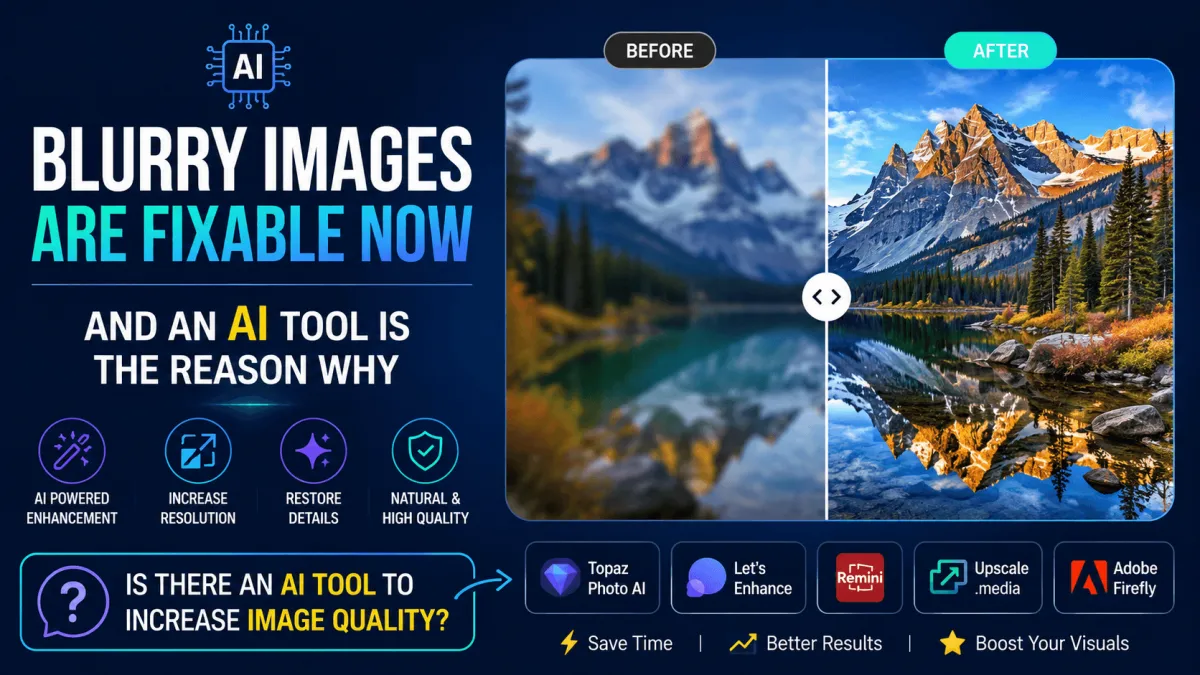
Images play a critical role in digital communication today. Businesses depend on product photos to drive sales. Marketers rely on visuals to attract attention across websites and social media platforms. Content creators use images to build stronger engagement with audiences. Unfortunately, image quality problems remain common despite advances in camera technology.
Many people still upload blurry, compressed, or low resolution images without realizing how much these visuals affect credibility and performance. Poor quality images can reduce trust, weaken branding efforts, and create a negative user experience. This challenge has led many users to ask a simple question: is there an AI tool to increase image quality?
The answer is yes. Modern AI image enhancement technology can improve image sharpness, resolution, and overall clarity far more effectively than traditional editing methods. Understanding how these tools work can help individuals and businesses make better decisions when restoring or improving visual content.
Why Low Image Quality Is Still a Big Problem for Creators and Businesses
Image quality issues affect organizations of every size. Many businesses still rely on photos captured with mobile devices under less than ideal conditions. While smartphone cameras have improved dramatically, image quality can still suffer because of poor lighting, compression, or improper resizing.
Ecommerce businesses frequently encounter this challenge. Product images may appear acceptable on small screens but reveal flaws when viewed on larger displays. Blurry edges, missing detail, and poor sharpness can make products appear less professional and less trustworthy.
Social media platforms introduce another problem. Images are often compressed automatically during upload. Compression reduces file size but frequently removes important visual details. As a result, originally sharp images can become noticeably softer after publishing.
Designers face additional frustrations when attempting manual corrections. Traditional editing software offers sharpening and enhancement features, but these tools require skill and time. Even experienced editors often struggle to recover lost detail naturally.
Businesses managing large image libraries face even greater challenges. Updating hundreds or thousands of images manually is rarely practical. This growing need for efficient image enhancement solutions has accelerated interest in artificial intelligence powered tools.
So Is There Actually an AI Tool to Increase Image Quality?
One of the most common questions online today is is there an AI tool to increase image quality. Many people assume image upscaling simply stretches existing pixels and creates larger but blurrier images.
That assumption was often true in the past. Traditional image enlargement methods relied heavily on interpolation techniques. These methods estimated additional pixels based on surrounding information, frequently producing soft or unrealistic results.
Modern AI image enhancement works differently. Instead of merely enlarging an image, artificial intelligence analyzes visual patterns and predicts missing details. Machine learning models are trained using millions of images, allowing them to understand textures, edges, objects, and visual structures.
When users increase image resolution with AI, the system attempts to reconstruct realistic details rather than simply stretching existing information. This process often produces noticeably sharper and more natural results.
The growing popularity of these tools has also created confusion. Many users expect miraculous transformations from severely damaged images. While AI can significantly improve image quality, it still operates within practical limitations. Understanding what these tools can realistically achieve is essential for setting proper expectations.
How AI Tools Improve Image Quality Without Destroying the Original
Traditional sharpening methods often create undesirable side effects. Excessive sharpening can introduce noise, produce visible halos around edges, and make images appear artificial. These issues frequently reduce overall image quality instead of improving it.
AI enhancement tools use a more sophisticated approach. They analyze image structures and identify patterns across different visual elements. This allows the software to distinguish between important details and unwanted artifacts.
Rather than increasing contrast aggressively, AI focuses on improving texture definition and edge clarity. The enhancement process is designed to preserve natural appearance while increasing visible detail.
Facial features provide a good example of this capability. Older enhancement techniques often produced unnatural skin textures and exaggerated details. AI systems can recognize facial structures and apply improvements more intelligently.
Landscape photography benefits as well. Trees, mountains, clouds, and architectural details often contain complex textures that traditional editing methods struggle to enhance effectively. AI models can identify these patterns and reconstruct them more accurately.
This intelligent analysis explains why many users searching is there an AI tool to increase image quality are impressed by the results modern platforms can deliver. The technology focuses on improving perceived detail rather than simply increasing image dimensions.
Best Use Cases Where AI Image Quality Tools Make the Most Difference
AI image enhancement tools can provide substantial value across many industries and creative workflows. Some applications benefit more than others depending on image quality issues and project requirements.
Photo restoration remains one of the most popular use cases. Families often possess valuable photographs that have deteriorated over time. Low resolution scans and faded images can be improved significantly using AI powered restoration software.
Ecommerce businesses represent another major user group. Product photography directly influences purchasing decisions. Enhanced product images often appear more professional and create stronger visual appeal for potential customers.
Marketing departments frequently rely on historical assets created years ago. Older campaign materials may not meet current resolution requirements for modern displays. AI tools help extend the usefulness of existing content without requiring complete redesigns.
Real estate professionals also benefit from image enhancement technology. Property photos often require improved sharpness and clarity before publication. Better visuals can attract more attention and generate stronger engagement.
Content creators across blogs, websites, and social media platforms increasingly use AI enhancement solutions to improve image presentation. At Ai Innovative Tools, we regularly observe growing interest in image quality improvement technologies among marketers and creators seeking better visual performance.
Top AI Tools Available Right Now for Increasing Image Quality
Several AI powered platforms currently offer image enhancement capabilities. Each tool serves different audiences and use cases, making careful selection important.
Topaz Photo AI is widely recognized for professional quality image enhancement. It provides advanced sharpening, noise reduction, and upscaling features suitable for photographers and creative professionals.
Upscale.media offers a user friendly cloud based solution. The platform focuses on quick image enlargement and quality improvement without requiring advanced technical knowledge.
Let's Enhance provides AI powered upscaling with additional enhancement options. Businesses frequently use the platform for ecommerce and marketing images.
Adobe Firefly and Adobe Photoshop have also introduced AI powered enhancement features. These tools integrate image quality improvements within broader creative workflows.
Remini remains particularly popular for portrait enhancement. The platform specializes in facial restoration and image clarity improvements for personal photography.
Many users searching is there an AI tool to increase image quality download the first option they find online. Unfortunately, different tools perform better on different image categories. Portraits, products, landscapes, and historical photographs often require specialized enhancement approaches.
Free versions can be useful for testing. However, many providers restrict output resolution or apply watermarks to generated images. Reviewing feature limitations before choosing a platform helps avoid disappointment later.
Limitations to Know Before You Rely on AI for Image Enhancement
Despite impressive advancements, AI image enhancement technology still has limitations. Understanding these boundaries helps users make more informed decisions.
Severely damaged images remain challenging. If large portions of an image are missing or heavily corrupted, AI systems may struggle to generate realistic replacements. The software can make educated predictions but cannot perfectly recreate unavailable information.
Extremely pixelated images present another difficulty. AI can improve appearance substantially, but it cannot recover details that were never captured by the original camera sensor.
Image quality improvements also vary based on source material. High quality originals typically produce stronger enhancement results than heavily compressed files.
Processing speed can become a concern for organizations managing large image libraries. Batch enhancement projects may require significant computing resources depending on image quantity and output resolution.
Some AI systems also introduce minor inaccuracies during reconstruction. While these changes are often difficult to notice, they may matter for scientific, medical, or forensic applications where visual accuracy is essential.
Recognizing these limitations allows users to evaluate enhancement results more realistically and select appropriate workflows for their needs.
How to Choose the Right AI Image Quality Tool for Your Workflow
Selecting the best solution involves more than comparing prices. Different tools offer varying capabilities, performance levels, and workflow integrations.
File format compatibility should be evaluated first. Some platforms support a wide range of image formats while others focus on standard file types only. Choosing a compatible solution prevents unnecessary workflow complications.
Output requirements also influence tool selection. Businesses creating large print materials may require higher resolution exports than social media marketers. Understanding final usage helps determine appropriate enhancement capabilities.
Organizations processing large image volumes should consider automation features. Bulk processing options can dramatically reduce manual effort and improve operational efficiency.
API availability becomes important for companies integrating image enhancement into existing systems. Automated workflows can streamline content production and reduce repetitive tasks.
Testing remains one of the most effective evaluation methods. Running sample images through several platforms allows users to compare quality, speed, and ease of use before committing financially.
For anyone still asking is there an AI tool to increase image quality, the evidence is clear. Modern AI enhancement platforms can dramatically improve image sharpness, resolution, and visual appeal when used appropriately.
As artificial intelligence continues advancing, image enhancement technology will likely become even more accurate and accessible. Businesses, marketers, photographers, and content creators who understand these tools today will be better positioned to produce stronger visual experiences tomorrow.
Conclusion
Image quality plays a major role in how audiences perceive your content, products, and brand. Blurry or low resolution images can reduce engagement, weaken trust, and limit the effectiveness of your marketing efforts. Fortunately, artificial intelligence has made image enhancement more accessible than ever before.
If you have been wondering, is there an AI tool to increase image quality, the answer is absolutely yes. Modern AI image enhancement tools can sharpen details, increase resolution, reduce noise, and improve overall visual clarity without requiring advanced editing skills. While these tools cannot perform miracles on severely damaged files, they can deliver impressive improvements for most everyday images.
The key is choosing the right tool for your specific needs and testing it with real examples before committing to a long term workflow. Whether you are restoring old photographs, improving ecommerce product images, or upgrading marketing assets, AI powered image enhancement can save valuable time while producing better results.
At Ai Innovative Tools, we closely follow the latest advancements in artificial intelligence and digital creativity tools. Our goal is to help readers discover practical AI solutions that improve workflows, increase productivity, and deliver better results across different industries.