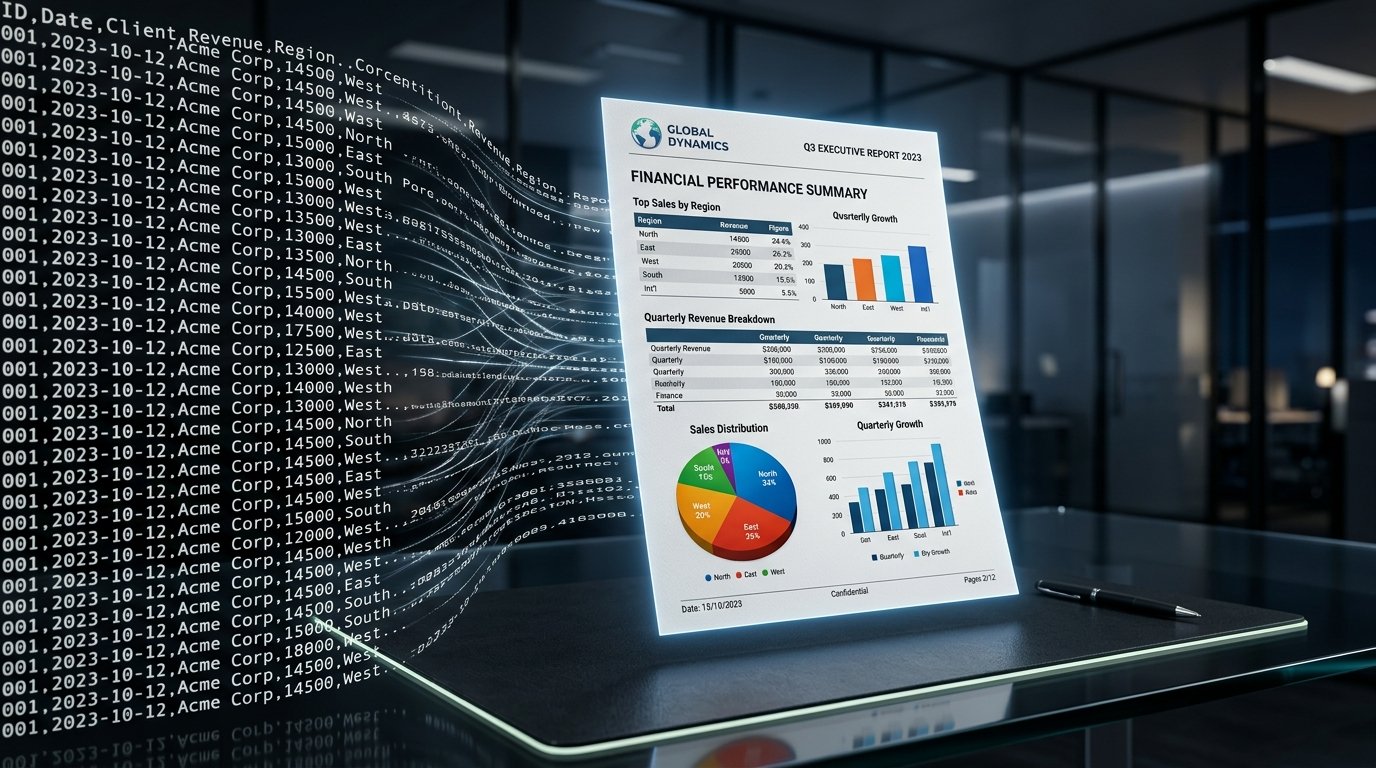
💡 Quick Answer: What is Baidu's Open-Source AI OCR (PaddleOCR-VL)?
Baidu has open-sourced PaddleOCR-VL-1.6, a lightweight 0.9B parameter Vision-Language Model (VLM) for optical character recognition and document structure parsing. Achieving a state-of-the-art 96.3% accuracy on the OmniDocBench benchmark, PaddleOCR-VL processes complex multi-column documents, mathematical formulas, and tables across 110+ languages. Developers can self-host this open-source engine to reduce OCR pipeline costs by 10x–20x compared to cloud vision APIs. For clean web document exports, try PDFCraft Text to PDF Converter.
Convert & Structure Documents Instantly
Export clean, structured vector PDFs from plain text or raw tables with PDFCraft.
Try Free PDFCraft Tools Now →Introduction: The Paradigm Shift in Open-Source Optical Character Recognition
For nearly two decades, enterprise optical character recognition (OCR) was dominated by two extremes: legacy rules-based engines like Tesseract that struggle with complex layouts, or expensive cloud APIs (AWS Textract, Google Cloud Vision, Azure AI Document Intelligence) that charge per page and process data on third-party servers.
Baidu’s recent open-source release of PaddleOCR-VL has fundamentally shifted this landscape. By combining traditional detection-recognition pipelines with a compact 0.9 Billion parameter Vision-Language Model (VLM), Baidu has made state-of-the-art multimodal document extraction freely available under an Apache 2.0 open-source license. With over 73,000+ stars on GitHub (PaddlePaddle/PaddleOCR), PaddleOCR is now officially the most widely adopted open-source OCR repository in global software development.
Key Innovations: How PaddleOCR-VL Achieves 96.3% Benchmark Accuracy
The core challenge in modern document processing is not merely recognizing characters, but understanding layout semantics. Traditional OCR engines read text from top-left to bottom-right, scrambling multi-column academic papers, financial ledger tables, and side-by-side translation boxes.
PaddleOCR-VL resolves this through a hybrid two-stage neural architecture:
- PP-StructureV3 Visual Layout Encoder: A high-speed Convolutional Neural Network (CNN) isolates document regions into logical tokens—identifying headings, body paragraphs, table borders, inline code, and mathematical formulas.
- Lightweight Autoregressive Decoder (0.9B VLM): A compact Transformer model decodes bounding box coordinates into structured Markdown, LaTeX equations, and JSON schema outputs.
- Multilingual Lexicon Alignment: Trained on a massive corpus spanning 110+ languages, including Chinese, English, Arabic, Japanese, Korean, and Cyrillic scripts.
📊 OmniDocBench 2026 Benchmark Scores
- PaddleOCR-VL-1.6 (Open Source): 96.3% (Self-Hosted GPU)
- Legacy Tesseract v5 (Open Source): 71.8%
- Proprietary Cloud Vision APIs: 94.5% – 95.8% ($1.50 per 1,000 pages)
Self-Hosted vs. Cloud APIs: The Economic & Security Case for Open-Source AI OCR
For engineering teams scaling Retrieval-Augmented Generation (RAG) pipelines or agentic LLM workflows, document ingestion costs scale exponentially. Processing 1 million document pages through cloud vision APIs costs between $1,500 and $3,000 per month in recurring API billing.
By deploying self-hosted PaddleOCR-VL container instances on standard NVIDIA T4 or L4 GPUs, organizations reduce operational processing costs by over 85% to 90%. Furthermore, processing sensitive legal contracts, medical health records, and private financial statements locally eliminates SOC 2 and GDPR compliance risks associated with uploading documents to third-party AI endpoints.
Integration Guide: Using PaddleOCR in RAG & Agentic Workflows
Modern AI frameworks such as RAGFlow, Dify, LlamaIndex, and LangChain have adopted PaddleOCR as their default document loader. When ingestion pipelines convert unstructured PDFs into clean Markdown or vector chunks, PaddleOCR-VL preserves table cell relationships and Markdown headers, drastically improving embedding vector search accuracy.
- Install the PaddleOCR Python Package: Run
pip install paddlepaddle paddleocrin your virtual environment. - Initialize the Structure Model: Instantiate
PP-StructureV3to output structured JSON boxes with cell coordinates. - Pipeline Ingestion: Pass extracted Markdown chunks into your vector database (Chroma, Qdrant, or Pinecone) for retrieval search.
How PDFCraft Complements Your Open-Source Document Workflow
While Baidu's PaddleOCR excels at extracting text from images and scanned files, developer teams also need fast, client-side tools to re-package, structure, and convert extracted text into clean, shareable PDF documents.
Using PDFCraft Pro Tools, you can instantaneously convert extracted Markdown, CSV data tables, formal letters, and clean developer notes into print-ready vector PDFs directly in your browser without uploading files to external servers.
Frequently Asked Questions (FAQ)
Can PaddleOCR-VL run on consumer CPU hardware?
Yes. While GPU acceleration achieves sub-50ms inference times per page, Baidu provides optimized Intel OpenVINO and ONNX Runtime quantizations that process scanned documents on multi-core CPUs in 200–400ms per page.
Is Baidu PaddleOCR completely free for commercial use?
Yes. The entire PaddleOCR repository, including pre-trained weights for PP-OCRv5 and PaddleOCR-VL, is licensed under the permissive Apache 2.0 license, allowing unrestricted commercial deployment in proprietary applications.
How does PaddleOCR handle handwritten or distorted documents?
PaddleOCR-VL includes dedicated spatial transformer networks (STN) that rectify warped, rotated, or uneven camera captures before text recognition, achieving significantly higher accuracy on physical document photos than traditional baseline engines.
Build Better Document Pipelines Today
Combine open-source AI OCR with PDFCraft for lightning-fast document generation.
Explore PDFCraft Free Tools →